Patents Court decks defendant in UK unregistered designs case
In the recent decision handed down on 4 September 2025 (J Mac Safety Systems Ltd v Q Deck Safety Systems Ltd [2025] EWHC 2241 (Pat), the Patents Court (under the Shorter Trial Scheme) ruled in favour of the claimant finding that the defendant had infringed the UK unregistered design right ("UKUDR") of a safety decking system design used on construction sites.

The court clarified that ‘original’ in UKUDR law aligns with the EU test under copyright law, as opposed to having its own originality threshold. This means a design is original if the expression of the design is the product of the author's own intellectual creation.
Background
The claimant, J Mac Safety Systems Limited ("J Mac"), asserted unregistered design rights in four safety decking system designs created by its managing director, Mr Luis McCarthy ("Macdeck Designs"):
- 1x1 panel design;
- 0.75x1 panel design;
- Panel perimeter design; and
- Pin design.
The defendant, Q Deck Safety Systems Limited ("Q Deck Safety"), previously a customer of J Mac, purchased nearly £1 million worth of Macdeck products. In 2020, Q Deck Safety had attempted to re-negotiate its business arrangement with J Mac in order to reduce costs, but this had failed. Before that engagement in 2019, Q Deck Safety had started to look into, and ultimately developed, its own system ("Q-Deck Design"), which J Mac later claimed infringed its design rights.
Don't miss a thing, subscribe today!
Stay up to date by subscribing to the latest IP insights from the experts at Fieldfisher.
Issues
The court considered whether:
- The Macdeck Designs were original or commonplace;
- The "must fit" exception applied;
- Specified features were surface decoration;
- Specified features represented a method or principle of construction; and
- Q-Deck Designs infringed J Mac's design rights.
Reminder of the law for UK unregistered design right
1. Subsistence
Section 213 of the Copyright Designs and Patents Act 1988 ("CDPA") sets out the relevant provisions governing unregistered design right as follows:
1. Design right is a property right which subsists in accordance with this Part in an original design.
2. In this Part "design" means the design of the shape or configuration (whether internal or external) of the whole or part of an article.
3. Design right does not subsist in—
(a) a method or principle of construction,
(b) features of shape or configuration of an article which—
(i) enable the article to be connected to, or placed in, around or against, another article so that either article may perform its function, or
(ii) are dependent upon the appearance of another article of which the article is intended by the designer to form an integral part, or
(c) surface decoration.
4. A design is not "original" for the purposes of this Part if it is commonplace in a qualifying country in the design field in question at the time of its creation; and "qualifying country" has the meaning given in section 217(3).
Part of an article
As set out above, under UKUDR, protection can be afforded to "the design of the shape or configuration (whether internal or external) of the whole or part of an article". Q Deck Safety disputed that the panel perimeter design was "part of an article". It is worth noting that before 1 October 2014, a UKUDR could subsist in "any aspect of the whole or part of an article". This was then amended by the Intellectual Property Act 2014 which removed the words "any aspect of" from s.213(2) CDPA. This was to prevent claims for 'disembodied features, arbitrarily selected, which are not, in design terms, part of the design' - a comment made by My Justice Henry Carr in Neptune (Europe) Ltd v Devol Kitchens Ltd. Henry Carr J went on to consider the difference between aspects and parts of a design, stating, "in my view, aspects of a design include disembodied features which are merely recognisable or discernible, whereas parts of a design are concrete parts, which can be identified as such."
Originality
J Mac's position was that the test for originality of a design in the context of section 213(1) was the traditional UK test noted in the cases of Whitby Specialist Vehicles v Yorkshire Specialist Vehicles and Action Storage Systems v G-Force Europe – that being whether "sufficient skill, effort and aesthetic judgment has been expended on the new design". Q Deck Safety on the other hand relied on the test set out in EU case law, including Infopaq, Cofemel and Brompton, i.e. requiring the design to be the expression of the author's own intellectual creation. J Mac was not disputing that the EU copyright test for originality was the incorrect test in copyright law, but disputed whether it should apply in a designs case.
Commonplace
In Ocular Sciences Ltd v Aspect Vision Care Ltd, Laddie J had explained that while the term “commonplace” shouldn’t be redefined in the CDPA, it generally refers to designs that are "trite, trivial, common -or-garden, hackneyed or of the type which would excite no particular attention" to those in the relevant field. Importantly, even if a design uses familiar elements, it can still be protected if the combination of those elements creates something new and distinctive. The key is that the overall design must not be commonplace.
Exclusions
- Method or principle of construction: excludes overly generalised design concepts
- "Must fit" exception (also known as 'interface provision'): originally drafted to stop a designer preventing others from making parts to fit their equipment
- Surface decoration: excludes purely decorative features
2. Infringement
Design infringement is governed by sections 226–227 CDPA:
- Primary infringement occurs when someone copies the design to make articles exactly or substantially to that design without permission.
- Secondary infringement includes importing, selling, or dealing in infringing articles knowingly or with reason to believe they infringe.
Judgment
There had been a claim for passing off, but on the first day of the trial, Q Deck Safety agreed to submit to judgment on the basis of its pleaded case and the judge found in favour of J Mac. There had also been a claim for registered design infringement which had been discontinued earlier in the case, just leaving the claim for unregistered design infringement to be decided.
- Originality and commonplace designs
Originality
It was necessary for the judge to resolve the relevant law that applied in order to determine whether the Macdeck Designs were original under s.213 CDPA.
The judge concluded that the relevant principles set out in EU law copyright law should apply to this designs case. The judge agreed with the authorities cited that the appropriate interpretation of the CDPA is that the word 'original' in s.213(1) (i.e. for designs) should be given the same meaning as the word 'original' in the s.1(1)(a) CDPA (i.e. for copyright). This means a design is original if it reflects the designer’s intellectual creation - the EU copyright test for originality. The judge did not apply the traditional UK copyright test which requires the design to be the result of the designer’s own sufficient skill, effort, and aesthetic judgment. The court stressed that sufficient evidence was needed to determine whether the author "expressed [their] creative ability in an original manner by making free and creative choices" (para 63). The judge found that Mr McCarthy "had demonstrated he sufficiently expressed his intellectual creativity in creating the Macdeck designs by reflecting his personality, as an expression of free and creative choices…" He had enough flexibility to express his own style in the visual elements he created. In applying ECJ case law, the judge found all four designs to be original –
- Panel designs (1x1 and 0.75x1): Key factors included overall shape, hole size, number, shape, spacing, and placement within the design.
- Panel perimeter: The design was not solely functional; the judge found originality in the author's choices regarding hole arrangement and dimensions.
- Pin design: Despite functionality influencing aspects of the design, the judge concluded these features did not entirely dictate its form.
The originality finding stood despite J Mac referencing existing designs.
The designs were made available for sale or hire in 2016, starting the 10-year protection period under sections 216(1)(b) and 216(2) CDPA.
Commonplace designs
The judge dismissed Q Deck Safety's claim that the features were commonplace under s. 213(4) CDPA. None of the Macdeck Designs were commonplace, with key points being:
- Textured surfaces are typically used for grip, but the raised patterns were not widely used or functionally required;
- The pin head shape was distinctive, and J Mac's version was not proven to be common; and
- While perimeter holes are often functional (for example, for draining or fixing), the specific arrangement was not shown to be standard.
- Must fit/interface function
Under section 213(3)(b) CDPA, features “dependent upon the appearance of another article of which the article is intended by the designer to form an integral part" are excluded. The judge found that some features of the Macdeck pin design, with disc shapes at the point and head of the pin's shaft, enabled the pins to be connected to, or placed in, the support connector/panels to perform their function. Those features were therefore excluded from design right protection under the 'must fit' exception. However, what remained of the three other designs was still sufficient to constitute designs under s. 213(2) CDPA.
- Surface decoration
The Macdeck panel design featured two concentric circles, raised in minimal 3D, at their centre, between which was a roundel shape to add a logo. The judge found in favour of Q Deck Safety, agreeing that a reasonable consumer would view the shape as merely decorative and therefore not eligible for protection under UKUDR, as it was deemed to be surface decoration.
- Method or principle of construction
Q Deck Safety argued that some aspects of the Macdeck Designs, including unspecified angles, edge shapes, and surface patterns, were vague and general. It also maintained that J Mac's particularisation of the designs supplemented the drawings without expanding the scope of the design or constituting a claim to a method or principle of construction. Additionally, it indicated that there was no evidence showing the designs’ functions could only be accomplished with a specific shape.
The judge determined that the exclusion for method or principle of construction did not apply to the Macdeck Designs, as they were found to be sufficiently specific, and that J Mac's reference to both the drawings and particularised features was appropriate.
In relation to perimeter panel only, Q Deck Safety had disputed that the panel perimeter was a design for 'part' of an article. It argued the panel perimeter design was a "disembodied aspect and therefore not a discrete part of an article", so not eligible for protection under the CDPA. The judge disagreed with Q Deck Safety's allegation and found that the detail set out in the design drawing and particularised in the pleadings clearly defined the panel perimeter as a specific part of the design and not a vague feature.
- Infringement
The judge assessed whether the Q Deck Designs were made exactly or substantially to the Macdeck Designs See below comparison photographs included in J Mac's pleading:
| Macdeck | Q Deck | |
| Panel (and panel perimeter highlighted) | 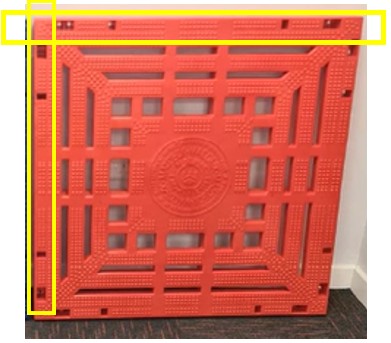 |
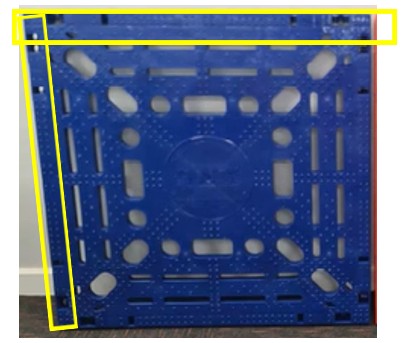 |
| Pin | 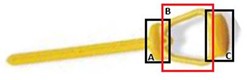 |
 |
Findings
The judge found that only the Q Deck 1x1 panel perimeter design was made exactly or substantially to the Macdeck 1x1 panel perimeter design. Therefore, this was the only infringing design. Although Q Deck Safety argued two differences to the Macdeck design (less dense but raised profile around the perimeter and rounded arch-shaped apertures), the judge found that these differences were minor to an objective observer.
The Q Deck 1x1 panel design (and therefore the Q Deck 0.75x1 panel design) were found not to be made exactly or substantially to the Macdeck 1x1 and 0.75x1 panel designs as the overall configuration and stylistic differences (specifically the aperture shapes, layout and surface bump patterns) lead to a different visual impression for the intended user. Further, Q Deck Safety deliberately created an 'X' shape on the panel to reduce any similarity to the Macdeck design, and the judge found that "there was extensive copying" but "the attempts by the Defendant to try to create a design on the 'right side of the line' were successful".
It is worth noting that although the Macdeck pin design did not qualify for protection due to the must fit exception (under s. 213(2) CDPA), the judge continued to assess infringement and found that the Q Deck pin was made exactly or substantially to the Macdeck pin design as the shape (such as the disc shapes and trapezoid aperture), proportions and dimensions were found to be nearly identical.
Q Deck Safety was found to have knowledge of infringement, meeting the secondary infringement criterion under s. 227 CDPA. For example, internal communications showed concern about making the design "different enough" to avoid IP issues (para 221). While Q Deck Safety contended that they believed no enforceable design right existed, the judge concluded that this mistaken belief did not negate the required knowledge.
Comment
This decision clarifies the standard of originality for UK unregistered design rights, aligning it with copyright law – i.e. the design must be the author’s own intellectual creation, not merely the result of skill and labour. It underscores the importance of documenting creative choices, to ensure that they are directed at the 'designer's intellectual creation' test and provides guidance on exclusions and infringement assessment, through the same lens of intellectual creation.
The case also demonstrates how UK unregistered designs can protect functional and modular products. Therefore, designs influenced by technical constraints can still be original if the designer has creative freedom with room for expressive choices, reflecting his personality (as with copyright – see our blog here on the Brompton Bicycle case: CJEU gets a handle on whether copyright subsists in Brompton bicycle, but ultimate decision hinges on Belgian court ).
The case confirms that 'clearly circumscribed' 'parts' of a product can be protected (e.g. the panel perimeter), which is particularly important in cases such as these in relation to modular or composite products where only some elements will be considered novel. However, whilst it is a powerful tool under UK unregistered design law to be able to seek protection for parts of article, it must be used wisely. Designers should ensure any specified part is identifiable and "is a contiguous [i.e. entirely touching or connected and not disjointed] part of what is claimed and not a disembodied design.
Finally, the case is also a helpful illustration that in principle, there is nothing wrong with using an earlier design to assist with creating a new design, but as the judge said, "it comes with a risk if the differences are not enough." If Q Deck Safety had been successful in its attempts to be 'different enough' from the Macdeck System so that they were found not to have been made exactly or substantially to the Macdeck System, then there would have been no copying.

